

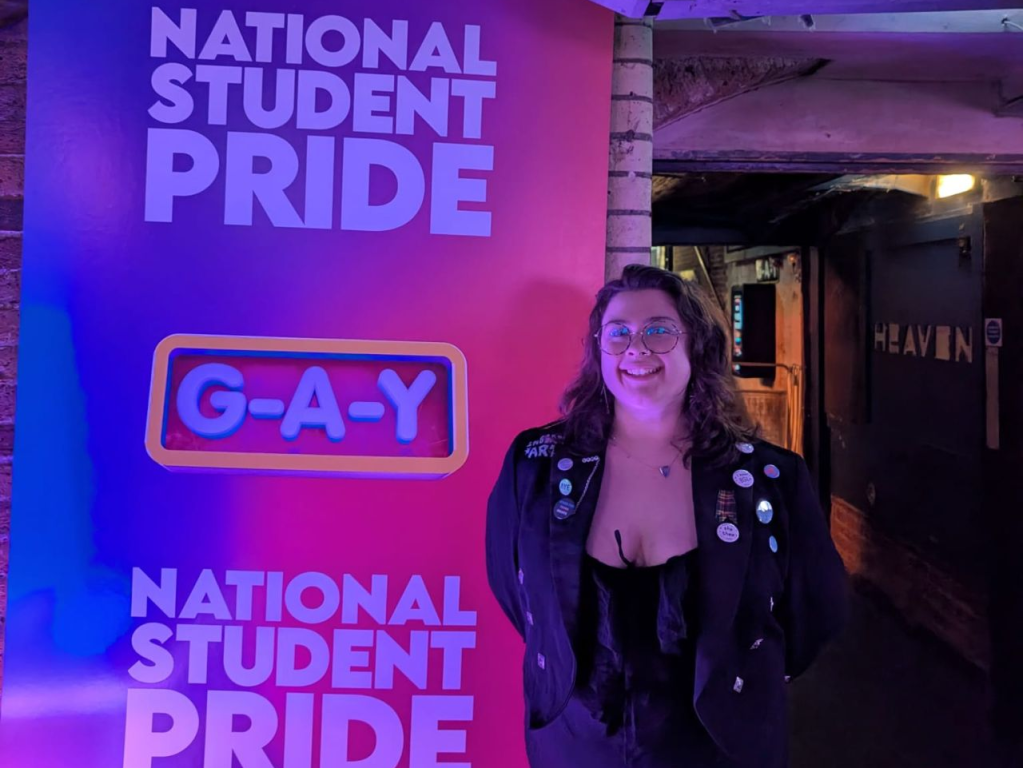
For Isabelle Westcott, moving to Scotland for university has been truly life-changing.
Growing up in the south of England, she came from a working-class background, and started to play football and support Bristol Rovers before beginning to explore her queerness as a pre-teen.
Having been football-mad, suddenly it became a space that did not feel particularly safe.
She began to feel like she was being targeted on the pitch in PE classes when they would play rugby or football, which led to her falling out of love with the game for several years.
“I think it was one of the earliest forms of queer discrimination I felt, in football and in sports more widely,” Isabelle recalled.
“When we were playing rugby or football in school, I would always be a hooker or a defender – positions I didn’t really like playing – so that I was out of the way, and I never had much of a choice in that.
“I sometimes felt like I got targeted on the pitch, so a part of my queer identity very early on was discovering what discrimination was, and that happened through football.
“It never particularly got better. For the five years that I was at high school, the entire time it was quite brutal.
“There was quite a lot of discrimination due to my queerness, and they couldn’t outwardly do anything elsewhere but if they really violently tackled me on the football pitch, they wouldn’t get in trouble, so that’s where it all happened.
“On the social side too, as much as I knew I loved football and watched every game of the World Cup and the Euros, it became something I really couldn’t identify with anymore.
“It sucked. Football is such a central, pivotal part of working class identities, so it meant that there were plenty of people in my life, including family members, who I couldn’t really connect with.
“I still loved Bristol Rovers, but at the time they were not a very accepting club and it wasn’t a very accepting atmosphere, so I couldn’t go to matches with my family or talk to friends about the thing I loved.
“People would ask me questions about the team that I couldn’t answer because I didn’t feel like I could be part of that space.”
As an extremely competitive person who loved team sports, Isabelle did try to find another outlet that may be more inclusive.
She tried badminton, and ultimate frisbee, but nothing clicked in the same way that football had – leaving her feeling like there was not a space in sport for someone like her.
As is so often the case for young LGBTQ+ people, a move for university proved pivotal. For Isabelle, that meant coming north of the border to Edinburgh.
Living in Leith, close to Hibernian’s Easter Road, a window was literally opened that would go on to change everything.
Isabelle continued: “I fell in love with Hibernian pretty quickly. I was sat in my flat one day, and I could hear Sunshine On Leith being sung from Easter Road – it’s powerful.
“Easter Road is also one of the stadiums where Scotland Women play some games at, so I could start going to that more often.
“I had a friend who was part of this supporters’ group for Hibs Women, and they were a very explicitly queer group – Hibs Affinity. They are very political, very left-wing, so I could find a space with them.
“I could be both queer and a football supporter. I could chant and sing, and say awful things to the referee, and it would all be in a space where I felt welcome.
“It was really special. It made me fall back in love with football, especially because I started uni in 2023, just after the Qatar World Cup which I boycotted because I was queer.
“Discovering how much I loved Hibs – and at the same time discovering how much I loved Scotland, and finding that there were spaces I could be queer in both of those – was amazing.
“Quite often in queer spaces, you find sports to be quite locked. There’s the whole ‘sportsball’ thing, so it was really nice to find a space where I could be both authentically. That all expanded when I found Slay FC.”
Slay FC is a subsidiary of Edinburgh University’s Pride Society, formed a couple of years ago by Poppy Watson and Ourie Ophir Azoulay as an inclusive space to go and play football.
At first, Isabelle had her misgivings about it. There may have been an element of hesitancy formed from her past experiences, and her acceptance that organised sport would not be an option for her as a trans woman.
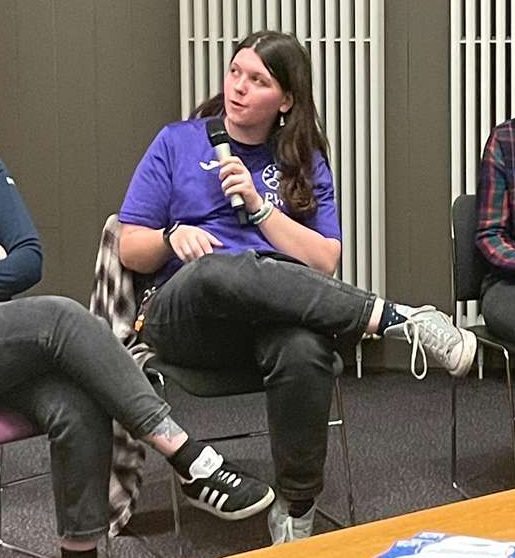
Within a couple of sessions, though, Isabelle knew that Slay was where she wanted to be.
“When people talk about going to university, they talk about the academic side and meeting people who are just like you – and they talk about joining sports clubs,” she reasoned.
“As someone who at this point knew I was a trans woman, and particularly vilified in the sporting community, that didn’t feel like something that was even an option for me.
“I was sad that I wouldn’t be able to experience that. I didn’t expect to find these things at all.
“I had heard about Slay when they first started up, and in about September 2024 I saw it on Instagram again and thought I’d go to it and see if it was fun, and see what’s happening.
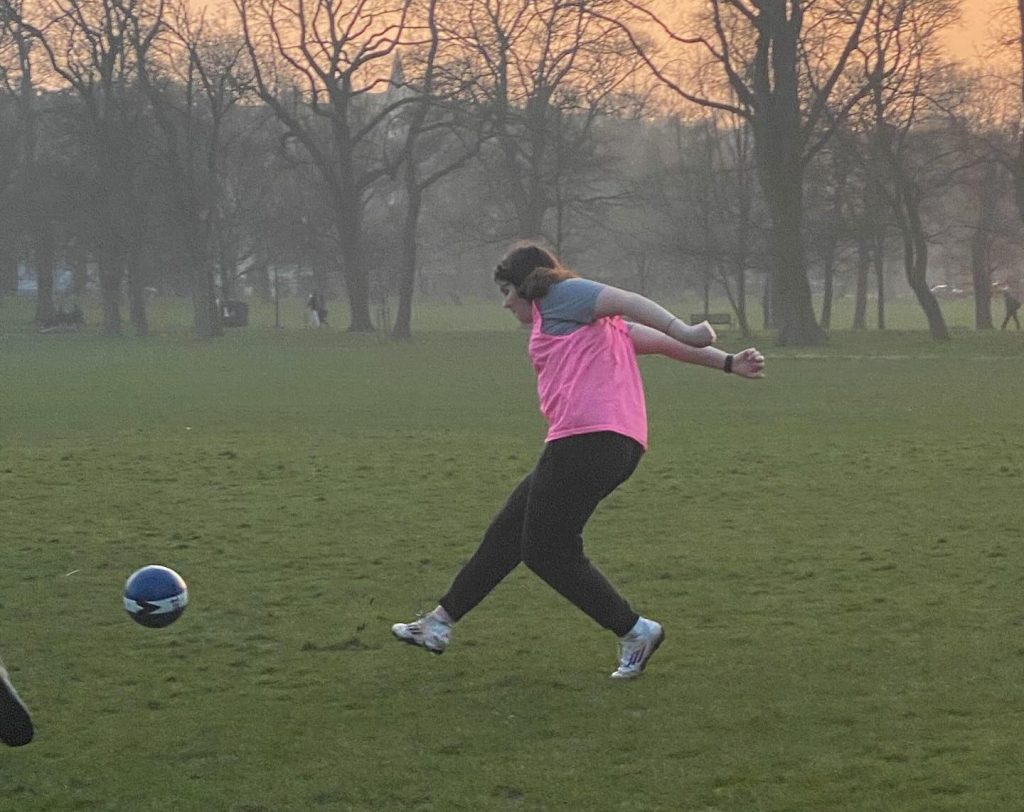
“I was really nervous at first, because I didn’t know anyone there. I barely even had stuff to play in – I think in went on to a very slippery Meadows in joggers, a t-shirt and some running trainers.
“I hadn’t kicked a ball in years, and playing football in any form again felt so amazing. Watching is an amazing thing, but playing is a whole other thing.
“I fell over so many times, but everyone was so lovely and really understanding. I felt like I got to shine for the first time in years, and show that I am genuinely good at football. I think I scored a goal in my very first game, and the adrenaline I felt was incomparable.”
As that very competitive person, Isabelle had to learn to adjust that particular element of playing sport, but it was made much easier by the environment she was in.
Games focused around having fun rather than winning, and social touches like bringing baked goods to share after the football, reinforced that tone.
For Isabelle, it was a world away from feeling scared every time she stepped on to a pitch in school.
“You would be joking with the other team, and if someone scored because you messed up as a defender, for the first time in my life it wasn’t that someone was annoyed at me, they were laughing at me about how stupid I looked,” she said.
“It has really made me feel like I don’t hate myself for my mistakes anymore, and I’m not scared when someone tackles me.
“I’m just having fun with football again, and that’s a really good feeling.”
Isabelle enjoyed playing with Slay FC so much that over the last academic year, she took on the role of Slay FC co-ordinator to run sessions and organise tournaments.
It all stemmed from a session that Ourie could not make, where Poppy volunteered Isabelle to run the session, sparking a passion that she did not even know she had.
That, combined with the personal positive impact Isabelle felt she had taken from the group, made it a no-brainer to take on more responsibility and make that transition from participant to organiser.
“I had so much love for the club and appreciation for what it had done – revolutionising my self-identity and changing my social life – that I wanted to give back,” Isabelle explained.
“I would say I met about 80% of my friends through Slay, or someone at Slay, so I really love it.
“I had been looking for something to put my time into anyway, something that I could do and that would make me feel good, and this was the perfect opportunity.
“Since September, we’ve had a barrage of new players coming in. I reckon about 80% of our players only started this year, so we’ve seen how much Slay has brought everyone out of their shells and created best friendships.
“We had multiple players who had never played football before, but now they love it and miss it every week they can’t go.
“It has completely changed my perspective. I used to think it was just fun, but now I think it genuinely has a very important role to play, and I’m very glad to help it keep playing that role.”
It is an ongoing debate about the value of queer-only spaces in sport compared to integration measures for people to join “mainstream” spaces.
For some, the last thing they would want is to be singled out. For others, a dedicated LGBTQ+ space may be the only way they feel comfortable in a sporting environment.
It was certainly more of the latter in Isabelle’s personal experience, albeit she accepts that in a perfect world the two would work together in unison.
“Even at this point, I think I would still be wary about going to a non-inclusive club, because it’s a really intimidating space and I don’t know if I would feel safe,” Isabelle pondered.
“A queer-focused space is what brought me back in, and it’s what means I’m able to do this advocacy in integrated settings.
“EDI initiatives are really important, but so are dedicated initiatives. I think it’s really important to have them in parallel.
“It is sad that there still has to be dedicated spaces, and in an ideal world queerness would just be seen as completely normal and completely integrated. The fact is that a lot of queer people feel unwelcome in sport, so I think creating a queer-specific space helps to bridge that gap a little bit.
“At the end of that bridge should be a completely integrated space, where everyone is the same. That’s what I feel like I have when I go and watch football matches.
“At a time where certain groups are being targeted politically, and we are political targets in the sporting world, I think it is really important to be able to have that bridge to bring people back in the first place.
“Once we can bring people back, we can have people in the space to talk about it, but if we don’t have that bridge it’s difficult to get anyone in that space in the first place.”
The first steps on that bridge have completely changed Isabelle’s outlook, and hopes for the rest of her life.
A physics student, she now hopes to be able to work in the third sector, ideally something blending together advocacy for LGBTQ+ people and sport like Slay FC has done.
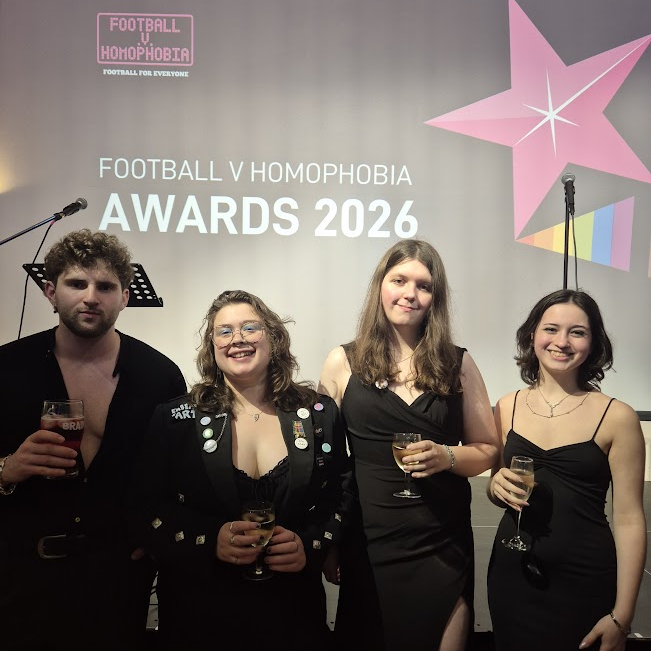
The whole club’s efforts have not gone unnoticed either, with Slay FC receiving the third place award at this year’s Football v Homophobia Awards.
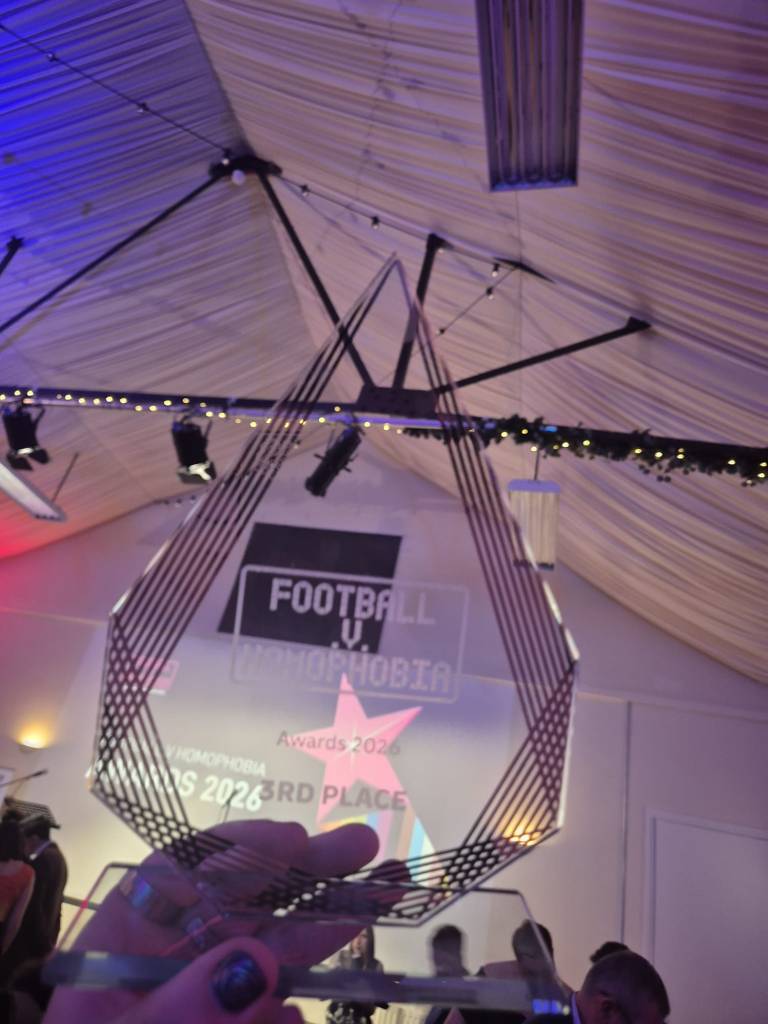
After a whirlwind 18 months, that was the first moment Isabelle had to really reflect on how much things have changed for her, and the impact that clubs like Slay can have.
“I spent three or four hours talking to like-minded people from all different backgrounds, and people that someone like me wouldn’t really have spoken to before, but in that moment I was surrounded by my peers who care about the same thing I care about,” Isabelle added.
“I spoke to people who had been playing since the 80s and running these clubs since the 90s, and I could say we were the first student club ever to do this.
“People I really respect, who work for the Premier League, were telling me that this is amazing, and that it’s awesome to hear that a university club has this space.
“Hearing that from people I really respect and admire made me really reflect for a while. I think for a solid week afterwards I was staring at the trophy just thinking ‘this is awesome’.
“It really does feel amazing. I look back on where I was even a year ago, and my life has changed so much.
“I’m so grateful, because so much of that is down to Slay FC. The skills that I’ve learned through the club, I think there are very few things I’ve ever been so passionate about in my life.
“It’s amazing to be a cog in the system. I think my greatest joy at Slay has been creating community, and making it so that people have a space where they feel like they can be themselves and be happy.
“Watching that from the sidelines has been the greatest joy in my life, and I can’t wait to see that on a greater scale.
“For the club, the future is really exciting. We’re going to be at the Qeltic Games, and we’ve got people who have played with Slay and gone back to other countries and started their own groups there.
“What I hope more than anything though is that it keeps being every Sunday at The Meadows. As much as I hope there are awards in our future and big games, my biggest hope is that it continues to be free and accessible every Sunday.”
 Pride of the Terraces
Leave a comment