

Some people, when taking on fundraising challenges, decide to run a marathon to really push themselves. While absolutely a mammoth task, Olivia Robinson decided to push things even further by walking from Land’s End to John O’Groats.
Raising around £10,000 for cricket youth charity Chance To Shine, Robinson incorporated visits to more than 50 cricket clubs along the way – sleeping at the vast majority of them overnight – meaning her odyssey took her past the 1000 mile (1600km) mark, taking 73 days to complete.
Cricket has played a vital role in Robinson’s life so far. She was a promising youngster in the Worcestershire academy, where she played to under-17 level and had the potential to go further, but struggles with an eating disorder and the knock on effect on her mental health brought her professional aspirations to a premature end.
Moving out to Australia around 15 years ago, she would then work as a massage therapist for Western Australia, but in recent years her focus has turned away from sport as a career towards art therapy.
Still, those memories of playing cricket growing up in the UK are burned fiercely into Robinson’s mind, right alongside those negative experiences.
Taking on a challenge like walking from Land’s End to John O’Groats, then, was a way of trying to change that narrative and create her own positive associations with the UK.

“I really wanted to create more space in my life, physically and metaphorically, to give me time to process my turbulent past,” Robinson said.
“My happiest place is out and about in nature, so it was about creating something that gave me space and time to give myself some therapy really.
“I left the country at a time when I was really unhappy – I was fighting for my life for a decade – and coming back to the UK over the years has been quite a turbulent experience for me. I wanted to change that narrative, put a positive spin on it and try to learn to love a country that I have left and view it from a positive light. That has happened, the walk has achieved that for me.
“I’m also just a bit mad. When you’ve been close to death, or experienced a really traumatic thing – or even really incredible things, like being an Olympian – it’s really hard to settle just doing mediocre things. I’m always looking for slightly extreme challenges to get that sense of excitement, awe and adventure.
“It was an absolutely incredible experience. Most nights I was trying not to cry because it was so touching.
“Seeing grassroots levels with kids and beginners, women who had never picked up a cricket bat before, all the way through to men’s first teams and seeing how they all embraced my challenge and get a positive reaction from what I was doing, it really gave me a sense of belonging.
“I had a sense of pride and felt like I was part of their club, even if I only passed through for a night.
“The thousands of people that I could enjoy the sport with was really special. It’s hard to put into words, because each club was unique – some places I was like a coach inspiring the next generations, at other clubs I was really humbled because the standard of cricket was so incredible.
“At other clubs it wasn’t even about the cricket, it was about the supporters. There was one club, Lanhydrok, where supporters were having beers, and these people who don’t even play cricket literally just go down to watch and have a beer with their mates. I have so many warm memories from the community all the way up and down the country.”

Although her aim for the challenge was very much internal settlement and to raise money for Chance to Shine, Robinson became a de facto ambassador for mental health and eating disorder awareness along the way.
People would naturally ask why she was walking so far, which began conversations and led to others opening up to Robinson as much as she did to them.
She may have expected conversations around her experiences with depression and anorexia to take place, but given girlfriend Amy was accompanying her on the trek a relatively unexpected part of those talks was her sexuality.
“It became more important for me to share the mental health piece of it as I went along, but that happened naturally because I realised that packed more of a punch and gave a bit more depth and meaning to the challenge I was doing,” Robinson explained.
“I’ve always been quite reserved about my sexuality, but Amy became such an integral part of the whole experience, and did so much behind the scenes to help me, that it became natural to be more open and talk about the fact that I am in a relationship with a woman.
“It is completely healthy and normal, and I was able to celebrate that as well. I didn’t realise that I would talk about that as I walked up the country, so that was a happy conversation that came out of it.
“I met a lady who does commentary for county cricket, and she was one of the first examples I saw of a player in the game who was in a lesbian couple when I was 12 or 13. I met her when I was back at my first club in Worcestershire, and I was able to thank her because I didn’t realise how important it was to have her as a role model.
“It was only years later that I realised that I could be that way and it would be alright. Hopefully, maybe, subtly along the way, I have shown the next generation or anyone else that it’s okay as well.”

Robinson’s sexuality has also been a beacon of her recovery, with her mum believing that she began to turn her life around when she came out. To that, Robinson continued: “It surprised me when she said that, but what I think it really represented was me feeling like I could be myself, whatever that looked like.
“It was bigger than me just being gay, it was about me being authentic. I never really felt like I fitted in at school, I never felt like I belonged, and I really struggled with a sense of identity and authenticity.
“Getting to know who you are and being comfortable in your own skin is really important to having a positive relationship with yourself and having good mental health.
“Being a lesbian comes into that, but for me it was a bigger picture of getting to know who I am and learning to love that person, which has taken decades. I’ve gone from wanting to end my life to really loving my life, and loving who I am in my life.
“It can take a lifetime for people to realise who they really are – what brings them joy and makes them happy. If I can just maybe inspire one or two people to look at their own lives and evaluate what brings them joy, and take steps to change it if needed, that’s what this walk represented.
“I don’t know many other people who would have thought this challenge sounded fun, but I was being true to myself. Mum was very insightful in knowing that I needed to be authentic to myself to get over the anorexia and depression that I was suffering from.”
In the past, Robinson has been frustrated that despite being in a very different place in her life, her past struggles with anorexia have almost defined who she is.
Part of this walking challenge’s aim, then, was to reclaim that control. To make that possible, and be the de facto ambassador that she has become, she needed to get to a place where she was comfortable with her own past, rather than embarrassed, ashamed, or spiteful.

That has been a relatively recent development, but it was something that helped lay the groundwork to take on a challenge like this to put that chapter behind her once and for all.
“Before, I didn’t want to be associated with it because I saw it as such a negative thing,” she reasoned.
“When I moved to Australia 15 years ago, I really loved the opportunity to reinvent myself. I didn’t have to bring that part with me, I could leave it all behind, and it was really freeing and important for my recovery to say that I’m Liv, I’m sporty, or a massage therapist, or an artist, and leave the anorexia out of it.
“It’s only now that it’s so not a part of my life that I feel like I can introduce it back in as a past thing, because it’s detached from who I am now.
“It needed time. I needed to fully disconnect from that, so it wasn’t a part of my identity. Now I feel like I can talk about it without it being a part of me, which is really nice. The healing has been done, which means I can be an advocate for it I think.
“It certainly feels like a different life. I just have so much empathy, and sadness, and love, for that child who went through it.
“It was absolute hell for over a decade, and it has helped me to be kinder to myself.
“As humans, life is hard and we do our best. Unfortunately my best was never enough when I was younger. That was one of the joys of this walk, because for the first time in many years I am extremely proud of who I am, what I have achieved, and who I have become.
“Saying that is only possible because I look back at that time when I was unwell with a loving and nurturing lens, rather than holding on to the hate and resentment I had towards myself for messing up my life.
“I lost the opportunity to represent my country in sport, or succeed in other areas, and I held that against myself for years. Now, I can see that I was just doing my best in trying to survive.
“If we can all be a bit kinder to ourselves, it makes life a bit easier. We’re all just trying our best, and we need to give ourselves a bit of extra love.”
In those darkest moments where, by her own description, Robinson no longer wanted to be alive, it was cricket’s light that just about shone through at the end of the tunnel.
In the same way that her mum feels coming out was a pivotal moment in her recovery, Robinson’s dad made every effort to ensure that sport remained something that Robinson could love and participate in, which gave her a motivation to get better.
“Getting back into that feeling of community, belonging and excitement really was the only incentive I had to want to get better,” she admitted.

“Sport is everything to me, I love it. Even though I’m now a full time artist, I still play five different sports a week.
“Even if it’s not sport, if it’s music or a shared passion for cooking, whatever it is, people in their nature need to feel like they belong to something, and that’s what cricket did for me.
“I’m so grateful that I had that reason to want to recover, because I personally know people who didn’t have a reason, a passion, or a hobby, and unfortunately they lost their battle with anorexia. They had no real incentive to want to get better, but I knew what came from being part of a sport – the connection, the belonging, the family-feel that’s really important to me.
“I can say that in hindsight, although at the time when I said I wanted to die and had no reason to live, my dad did propose an idea. He asked me to try and get better to get back on the team, and if I still decided I didn’t want to live, then fine, give up, end my life.
“Obviously it wasn’t easy, but when I got better and got back on the team, my mindset was better and I was healthier and stronger.
“I could feel the freedom that came with being healthier, and that helped me realise that life was worth living and I could find those moments of joy.
“It’s not that he tricked me into getting better, but I’m so glad that throughout the illness he would still take me to the driving range, or do a bit of tennis, or go and watch sport. I think he subconsciously knew that it would speak to Olivia rather than the illness, so that was really powerful for me.
“I have always been sporty, and I think he was just desperate to connect to the version of his daughter that was being lost, and was slowly fading away.
“He saw me at my most happy when I was on a sports field, so despite my mum disagreeing because I was obviously emaciated, he would insist on letting me still have exposure to sport and giving it a go, even if I probably wasn’t in the physical shape I should have been. I think he just wanted to find his daughter again, who had become so lost to anorexia.”
As well as sport, Robinson credits art with her recovery, as that was an outlet for her working through her emotions to become mentally stronger while sport and activity helped her be physically healthy, and she says both of those passions have saved her life.
It is fitting, then, that she brought those passions together by leaving artistic mementos at the clubs she visited along the length of the UK: a smiley-faced cricket ball and bat, drawn discreetly in every pavilion.
Now back in Australia, Robinson has plenty of reasons to be proud of what she has accomplished, and memories to last a lifetime. One particularly poignant stop on her tour, though, stands out.
“Endon Cricket Club in Staffordshire is only five miles from the hospital that I stayed at for a year when I was unwell,” Robinson added.
“There, Karen, who was the main organiser, created an event for 50 women. Most of them had never played cricket before, but we had a soft ball match, and then we had celebration food and drinks afterwards.
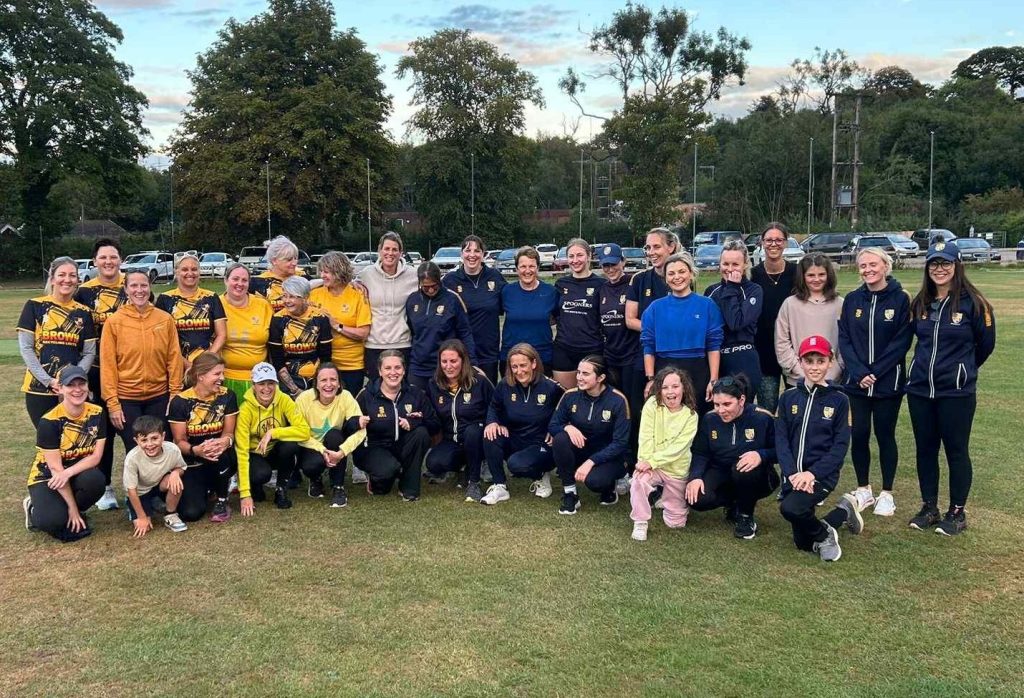
“I’d had a really tough walking day that day, cutting my legs and arms open going through brambles, and being chased by cows. It was just a really, really rough day, but that was so moving and powerful that I burst into tears afterwards.
“I actually went back to Endon after the challenge, because I wanted to round off the trip with a rematch. My family came and surprised me from Leeds, the Midlands and Manchester, and we repeated the match.
“I just had a moment where I was like ‘oh my god, I’ve done this’. Not to sound arrogant, but if it wasn’t for me these women wouldn’t have been there. This lady who swore she would never play cricket wouldn’t have been there in her bright yellow tutu, because she’s only doing it because I’m there. She had a great old time.
“It just pulled everything together and made me think it was really powerful.”
 Pride of the Terraces
Leave a comment