
Often, inclusive clubs become a beacon for LGBTQ+ people in their area. For the Brighton Seagals, that is slightly different.
As an inclusive football club in one of the UK’s most queer-friendly cities, the Seagals have a different role to play than similar clubs in other parts of the country.
Founded by Justine Thomson, the club offers both five-a-side and 11-a-side teams mixing competitive and social football for its 140 members. Thomson herself had loved football as a child, but did not properly start playing until she was 25 with a social group that would splinter off multiple times to become the Seagals.
The motivation behind those decisions to break away essentially came down to not feeling valued. Thomson, and other founding members, were used to things like getting second-hand kit from men’s teams, but wanted to create a place where they could be the priority.
Naturally, the majority of the Seagals’ membership identified as part of the LGBTQ+ community, and with the club open to women, trans and non-binary players there is something of a pathway for people who have never played before, or who are returning to the game, to work through the social side of the club – branded as the Brighton Seapals – into competitive football if that is what they want to do.
“We wanted to challenge the status quo on how a grassroots club should be run, and prove that you can do it really well and by the book, and it doesn’t have to be that difficult,” Thomson said.
“The majority of our membership is LGBTQ+, so we have always had a focus on what campaigns we can get involved in, and how we can make those voices louder for things like Rainbow Laces or Football v Homophobia.

“We want to be in those spaces so that we are being proactive. We have our pronouns on the website, we link people to support and fundraise for LGBTQ+ charities every year. We try to encompass that within our identity and ethos, and make sure everyone feels welcome regardless of what their gender or sexuality is.
“You look at the FA’s slogan of ‘football for all’, and that’s our approach. In Brighton we have a big population of LGBTQ+ people, so it’s not a surprise that a lot of people find spaces and then bring their friends along, because they have seen it’s a safe space.
“It’s important to have an offering and make it clear that they are welcome. Whether we are the right space for them or not is completely up to them, but they are welcome to come and try it out – and we can recommend other services or groups. We just want to say to people that we are here for them, they are welcome.
“I think we are quite lucky in Brighton, and I don’t think we should take it for granted that there are so many other organisations in place at all.
“For us, it was just about the people who started the club at the time wanting something that was suitable for our age group. It felt like there was stuff that was aimed at people who were retired who wanted to do a number of activities, and there were your normal football clubs, but not much in between.
“I almost feel like we’re a blend of all those spaces that are already here. We are a safe space for LGBTQ+ people and allies, we are a football team, and whilst we have mainly been known for our work off the pitch we do also have a really good offering on it that we are proud of.
“It feels like we were the first of our kind in the city. Other groups have started since – there’s a group called Trenbi who are specifically for trans and non-binary people, and a lot of their members who started it were with us before going and creating their own space.
“I don’t think there was anything that was specifically football for people of our age initially, that was really proactive in LGBTQ+ or any sort of diverse campaigning. Even here, we are a bit different. Maybe we don’t fit in, maybe that’s the point!”
Thomson spearheads a committee of nine people, who include an equality officer, welfare officer and three mental health first aiders.
That is a strong foundation for the club to continue to grow, and the Seagals have initiatives in place like having a kit bag that people can take from for free, or for a donation, to help break down barriers for people wanting to access football.
Thomson describes the people at the club as “a bunch of really good eggs” and hailed the club’s volunteers as “the beating heart of everything we do”, and their efforts have been rewarded with nominations at the last three Football v Homophobia Awards.
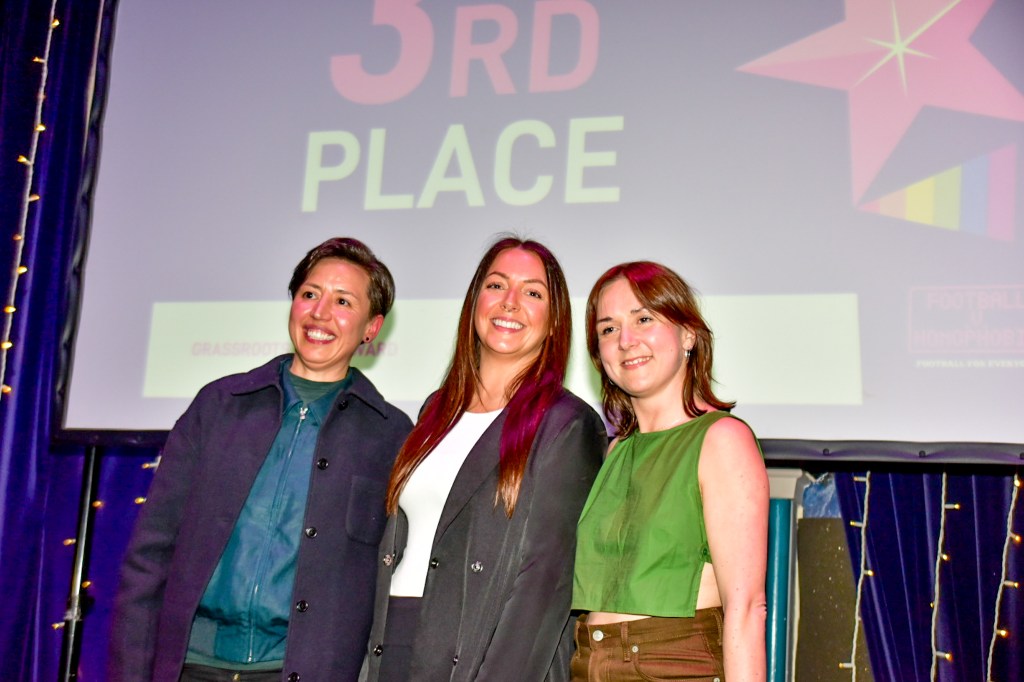
In 2023 the Seagals won the women’s award, before coming second in the same category in 2024 alongside a third place in the grassroots club award.
Earlier this year, there were another pair of nominations, as the south-coasters were again nominated in the women’s game and grassroots club categories, and while the Brighton outfit did not win either award their consistency in being shortlisted over recent years sets them apart from most clubs in the UK.
“This was the third year in-a-row that we’ve been shortlisted, which is really nice,” Thomson reflected.
“I am one of those people who is always wondering if they’ve done enough, and this last year has been more about things in the background – getting mental health first aiders in and stuff like that – so it’s the quiet, but important, things that we’ve been putting in place.
“It’s nice to reflect on that, and it’s really nice that people feel like we deserve to be shortlisted and to know that we’re setting a standard. Clearly people think we’re doing a good job, even when it feels stressful and stretched, because we’re being recognised.
“Out of all of the groups and all of the clubs in the country, they believe that we’re in the top three of those, which is amazing. It’s really something to be proud of, and I don’t think it’s something to be underestimated.
“It’s just an additional nice thing to know that the hard work we’re putting in is being recognised in some way, and if something comes of that then great.
“I don’t know if it would sound really egotistical to say that we’re an industry leader, but I would love to say that.
“I guess that’s what the shortlists say, that we are achieving and setting a standard, so I guess you could say the nominations are saying it for us. I like that, because I would love to be able to look back on this in a few years and say ‘look at how well we did there’.

“People might Google us, or find out a bit about us, or have a young person in their family who doesn’t know that there’s a football space for them, and it’s more about the impact of people associating us with what we are and knowing we don’t just say it.
“We have a local LGBTQ+ magazine, and they wrote an article on us about this year’s Football v Homophobia nominations. We didn’t contact them or do a press release, and that was really nice that they wanted to highlight us. You never know, off the back of that someone might want to get in touch with an opportunity.
“We do like to shout about our achievements. In the past we haven’t always wanted to blow our own trumpet, but actually it’s a really big deal, so we’re going to shout about it and be proud.”
Founding a football club has led to some new challenges coming Thomson’s way. As well as setting up the Seagals, she worked on Sport England’s Euros legacy project helping to grow recreational women’s football.
She already had a number of contacts in place and some understanding of the recreational football landscape, but suddenly even more connections were forthcoming – people who still remain supportive of the Seagals to this day.
As with any leadership position, decisions made by the club’s committee are never universally popular, but the direction of the club is led by their members – so if there becomes a particular desire for something, Thomson and the rest of her committee will do what they can to make it happen.
That passion for football and the Seagals has not faded in the slightest though. Thomson still happily gives up her time to ensuring that opportunities are there for people to make their way in the game, partially because of how she has benefited first-hand from inclusive football spaces.
“It has changed my life in the sense that I’ve found most of my friends through it,” Thomson added.

“Most of my friends before were old childhood friends or people that I worked with, but most of my adult friends came through football.
“It has really given me a much better work-life balance, because I’ve got something else to think about, and it keeps my body healthy.
“Also through working in football for a little bit, and knowing how to run a business and be around volunteers and looking after peoples’ money, there is so much that I’ve learned from it – what you should stick to your guns on, and what you need to let go of.
“I didn’t really play properly when I was a kid, but in my old team I felt like nobody really wanted to develop me and that I was always the last choice, but in this team we’ve brought in coaches who only want to create a great environment, and we have a group of really supportive teammates who will back each other to the end.
“It doesn’t happen often now, but if we were losing 7-0 we would still be laughing. One of the most important things the Seagals has taught me is that we don’t know everything, and it’s okay to make mistakes. If I make a mistake on the pitch, I know that my teammates won’t be rolling their eyes or annoyed at me, they will just tell me to keep my head up and move on, and I’d do the same for them.
“It has taught me what’s important, what to let go of, and I’ve even found my partner through the football club. It has had such a positive impact on my life, and given me the opportunity to give something back. I had never really done any volunteering before, but there is such a nice feeling about it.
“You don’t do it for the thank yous, but when someone does come up to you and say they saw this thing that you’ve done and it’s brilliant, or if someone says something that you relate to, it’s so nice to think that I’ve played a part in that. Even if people can get a tiny bit of the feeling that the Seagals has brought to me, I will be happy.”
 Pride of the Terraces
Leave a comment