
Over recent years there has been something of a shift in terminology in the inclusive sports space.
Whereas before teams and clubs would call themselves LGBTQ+ outfits, the preferred label seems to have become “inclusive” – which recognises that there are many other barriers that people face when it comes to getting involved in sport.
Often they go hand in hand. LGBTQ+ people are less likely to feel welcome in sport, which means they do not play as much as other people, which can then make it more difficult to get involved later in life as they do not think they are good enough.
Being cognisant of that, and creating a space where it is okay for people to learn their craft rather than being expected to perform to a high standard from day one, is key to helping people find their passion and stick with something for the long haul.
That is also true when it comes to disability inclusion. Opportunities to participate in sport in general are relatively rare, and can depend on access and availability of facilities where you live.
It becomes almost impossible to find a space in sport, though, when you don’t even know you have a disability.
Ailsa Davie threw herself headfirst into a number of different sports as a youngster, at various times trying football, hockey, fencing, archery, climbing, horse riding and netball. However, she never felt she was any good at any of them – a thought that was reinforced by coaches and teammates.
What she didn’t know at the time was that there may have been a reason she struggled in those settings more than her peers growing up – she is dyspraxic.

“The crux of it is, I loved sport as a kid but I was terrible at it,” Davie said.
“I had extra classes in primary school to teach me how to catch a ball – that’s how terrible I was at it.
“I joined a netball group, and I was one of the oldest kids there, but when they decided the teams they had an A team, A team reserves, B team, B team reserves and then me as the only one who wasn’t on any of the teams.
“I did sport all through high school, but I was usually put into goals because in school sports that’s where you do the least damage. I went off to uni and joined dance classes there, but although I went to a lot of the taster sessions for sport, at that level people are starting to get good and you can’t really join if you are terrible.
“Then at uni, I was diagnosed with dyspraxia, and suddenly I had an excuse for why I was so terrible at sports, so at that point I stopped doing them.
“I know that there is a lot of debate about whether people need diagnoses, but for me that diagnosis explained everything. Especially for dyspraxia, you are going through life being vaguely terrible at everything – right down to tying your shoelaces – but never knowing why if you’re not diagnosed.
“I remember feeling as a child that something was wrong with me, but I didn’t know why, so it absolutely made me look back and realise that it wasn’t just that I wasn’t working hard enough, or that I was terrible at things – those sports were actually 10 times more difficult for me than for everyone else there, and there was a reason why.”
Davie’s dyspraxia would have an impact on her everyday life, not just sports. Her diagnosis came in an educational setting, after years of being berated for not being able to finish schoolwork in time.
The turning point came after an exam where she hadn’t realised there was a back page to the paper, meaning she had only done 60% of the test. From that, though, she scored 58% – making her realise it was by no means an ability issue, but down to the time available.
In some ways, getting the dyspraxia diagnosis gave Davie validation and made her bolder. In others though, particularly when it came to her relationship with sport, it was a complicated situation.
“Before I got the diagnosis, I always had the thought in my brain that one day I would find the sport I was good at,” she reflected.
“I would get frustrated at myself when that didn’t happen, and when I couldn’t figure out why I wasn’t good at it. Even now that happens sometimes where I get weeks I am so frustrated at my brain, and the fact that I’m not progressing at the same level as other people, but having that reason for it does make it easier to deal with.
“I probably did find it harder to stick with sports when I didn’t have a reason, because I thought I was just terrible at them.
“It probably wasn’t good for my mental health, but it also wasn’t good for my dyspraxia. Whether you’re aware of it or not, that movement you get and being aware of your body is the best ‘treatment’ for dyspraxia. I maybe didn’t know the reason, but I did start to see those symptoms of dyspraxia get worse when I stopped doing sports so often.
“Dyspraxia is a weird one where you can’t access disability sports. You used to be able to for swimming, but that’s not a thing anymore and mainstream sports are harder to access too because of the motor co-ordination, but there was probably not much support that could have been provided to me as an adult.
“I think if I was diagnosed as a child I probably would have had occupational and physical therapy sessions that would have looked at those gross motor skills a little bit more. As an adult, to be honest, you’re kind of just left to get on with it.
“I got the assessment, and I got the diagnosis, and suddenly everything made sense why my shoelaces kept coming untied, and why my writing was so slow and took so much effort, why I still to this day am terrible at catching a ball, why it was like my body was working against me.
“In the first couple of years after I got that diagnosis, I started advocating for myself more. People would say I was using dyspraxia as an excuse, but I got really angry about that because it impacts on every area of my life, and for my entire childhood I didn’t realise what it was. Being able to say that the reason I can’t do something is that my brain works differently was a really powerful thing for me.”
It would have been easy to think that would be the end of Davie’s journey in sport, but eventually she would find a way back in.

Moving from her university base in Glasgow up to Inverness for work, she went on the lookout for LGBTQ+ spaces to get involved in, and one of the first she came across was a roller derby club – which has since evolved into the Ness City Rollers.
Finding queer spaces like the Inverness Kiki Family also helped expand her social circle, and a chance conversation with a friend helped to change her perspective on sport.
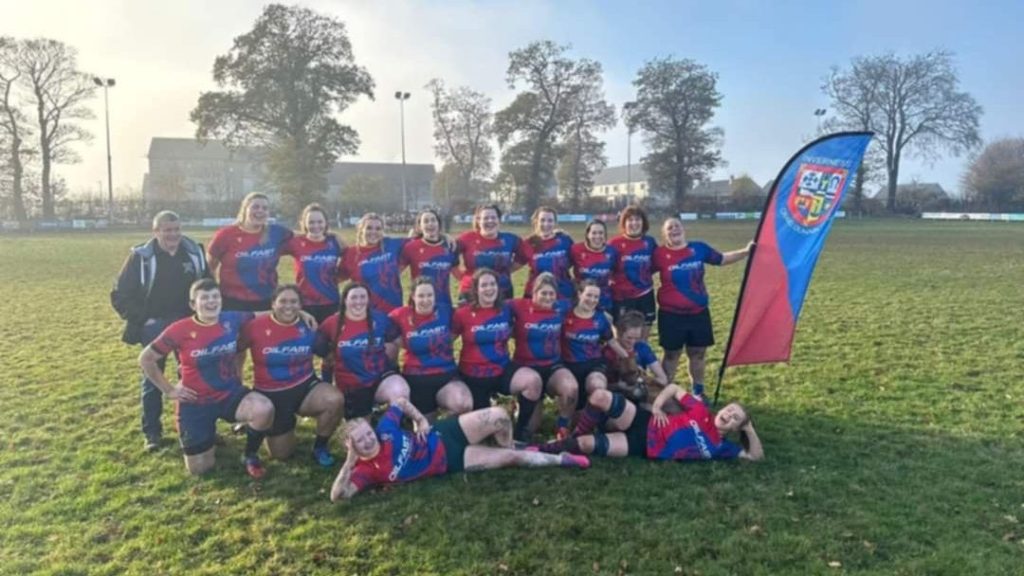
That then led to a decision to take up rugby with Inverness Craig Dunain, where Davie has been trying to learn the sport for the last few months – and has been loving every single second.
“Roller derby was something I had been interested in trying before anyway, but told myself that I couldn’t go along because of the dyspraxia because I’d be so bad at it,” Davie explained.
“I saw that they were LGBTQ+ friendly and that they did a learn to skate programme, and figured that it would be a good way to at least meet some other LGBTQ+ people up here and make friends, while also doing something physically active.
“I did that for a year and a half or so, and then I had a conversation with a friend in which I said I wasn’t sporty – like I had many times throughout my life – and something he said made me realise that I actually love sport, I just don’t give myself permission to do them.
“That was a turning point for me, because I realised that I was never going to be great at sport or compete at a top level, but I don’t have to. I can just enjoy it. I decided I needed to stop restricting myself from things that I wanted to do, so when I saw members of the rugby club flyering at Pride I eventually worked up the courage to go to their taster sessions.
“Again, they were LGBTQ+ friendly, and that was important to me. I think I’m at a stage in my life where I don’t want to be ‘the gay one’.
“I don’t want to have to educate people. I don’t mind doing that sometimes, but if I’m going to something that’s supposed to be fun, I don’t want to be that. I want to be in a place where I can talk about my girlfriend and not take a moment to question how people are going to respond. I think we all just like being normal, and not being othered.

“What I didn’t necessarily expect, but what I have found in rugby, is how normalised it really is there. In LGBTQ+ spaces, what you have in common is that you are LGBTQ+. In rugby, nobody really blinks an eye whether you are or not. It’s exactly the same response that people have when I talk about my girlfriend as others get when they talk about their boyfriends.
“I don’t think there is ever a room in women’s rugby where I am the gay one. Nobody bats an eye either way, we’re all just there because we love rugby.”
Even in the most welcoming environments possible, though, when you have been used to thinking people are judging you, or that sport isn’t for you, it will take some time for those historic insecurities to fade away.
Still relatively new to organised rugby, Davie naturally still has good days and bad days when it comes to her confidence level.
However, she is determined to keep going – both for her own enjoyment, and in the hope of showing others that dyspraxia does not have to be a barrier to participating in any kind of sport.
“Without even knowing, a lot of what Inverness Craig Dunain could do to help, they are doing anyway,” Davie added.
“Put me in the middle of a scrum and tell my to push – that’s where I’m happiest. They are such an inclusive group that they never make you feel like you are not welcome, and they celebrate your wins, whatever they may be.
“I think really all I need is that space and recognition that it will take me longer to learn things, but I will learn them.
“I’ve seen a lot of things online, especially when people are looking for sports to put their dyspraxic kids into, telling people to put them into individual sports because then they won’t be letting down a team. I internalised that for quite a while.

“I still have days where I am anxious at the thought of going to practice. That was the same when Ness City Rollers were doing derby, I would feel like people would be judging me because it took me longer to pick things up, but I think Inverness Craig Dunain is such an inclusive space that they never make me feel that way – when I do, it’s all in my head.
“There are some days where the anxiety is too bad for me to go to practice because it’s overwhelming, and there are other days where it’s there but I go anyway, and I always feel better for going – even on the days where I can’t catch a ball to save my life.
“That feels like something I want to inspire in others. When I joined the committee for Ness City Rollers, a big thing that I wanted to make sure happened was that the club would continue to be an inclusive space for everyone.
“I’ve had people say when I’ve tried to recruit that they couldn’t join because they are dyspraxic, and I see online people saying that they will never be a sports person, and I hate the idea of anyone feeling like they can’t do sports because of their dyspraxia. I hate that for so long I felt that way about myself, because why shouldn’t we be able to do sports like anyone else?
“Sports have so many benefits to people of all ages’ lives. There is something specific about group sports that gives you that camaraderie and that team spirit, those social connections which can be really hard to form as an adult. There is also pride in your own physical and mental health. Excluding a specific group from that feels wrong.
“It can still be a mixed bag for me. Most of the time, I love sports, and I’m loving it more and more. Forcing myself to keep going back, even if I’m not good at it, and building those relationships with my teammates is making me love sport even more.
“Sports make me happy, but I think sport will also always be something that is hard for me, and it will always be something that causes me those feelings of unworthiness.
“I never will pick things up as quickly as my teammates who don’t have dyspraxia. It does take me more time to learn those skills and internalise them, and I have to make them into muscle memory before I’m able to do them.
“I think there should be more dyspraxic sports places to allow those with dyspraxia to do sport with others like them. In mainstream sports, you are always going to have to work 10 times harder. I am happy to do that, but it is nice at roller skating to have other people who are like me.”
 Pride of the Terraces
Leave a comment